How to Cut Your Content Creation Time by 70%

In an effort to scale visibility and attract new clients, businesses fall into a highly seductive trap. They treat content marketing like a creative writing assignment, operating under the assumption that audience growth requires a relentless stream of fresh, ground-breaking ideas.
But treating yourself like an infinite idea generator is an operational flaw. What breaks when the owner tries to be a full-time "creator"?
The bottlenecks shift: The business becomes completely dependent on the founder’s spontaneous bursts of inspiration.
Consistency tanks: The moment operational demands or client emergencies peak, marketing is the first thing that gets dropped.
High-value strategy is traded for execution anxiety: The time you should spend refining operations or serving premium clients is spent staring at a blank screen trying to cook up an original LinkedIn post.
The most mature organizations and premium agencies don’t run on a creative treadmill. They don’t change their core philosophy every seven days. Instead, they master the art of repeating their best ideas until they stick.
True audience growth should be scheduled, not improvised. Moving your business from a state of marketing chaos to true operational autonomy requires a fundamental shift: you don't need new ideas; you need better distribution of your best ideas.
Less Creation, More Distribution
In a broken marketing model, content creation scales linearly with your visibility. If you want to show up on three different platforms, send an email, and update your blog, you double or triple your creative output. This is a fast track to founder burnout and low-budget brand signaling.
Sophisticated marketing systems look entirely different. Efficiency is the ultimate competitive advantage, which means your distribution expands while your creative input shrinks.
In practice, instead of managing a disjointed collection of isolated social posts, scattered emails, and ad-hoc videos, the entire monthly marketing ecosystem is fed by a single, high-leverage asset: The Anchor Blog.
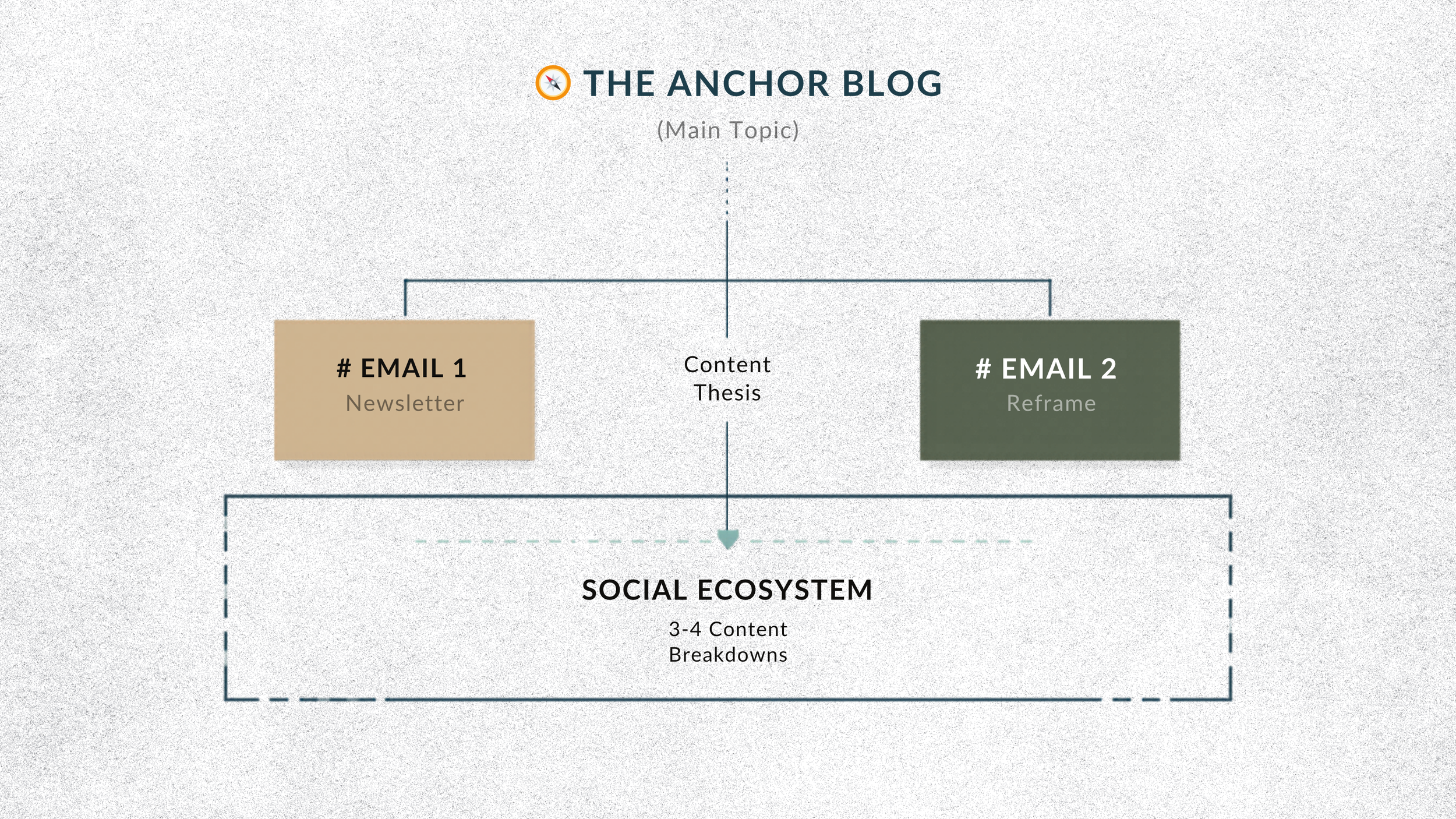
A breakdown of how a single blog can produce an entire month’s worth of content
Instead of falling into the never-ending trap of treating every post like it needs to be unique and viral-worthy, write a blog post on Tuesday, film a video reel on Wednesday that expands on that exact topic, and then deliver a high-value newsletter to your email list that ties the narrative together and drives traffic to these content posts.
By implementing an Anchor Asset, you establish a strict strategic filter: if an idea isn’t deep, valuable, or opinionated enough to sustain a comprehensive 1,500-word authoritative piece, it simply does not enter your ecosystem. This instantly eliminates corporate noise and forces your brand to stay hyper-focused on your core business pillars.
From One Big Idea to a Month of Marketing
Let’s lift the hood on how a single, comprehensive asset cascades throughout an entire month without requiring any fresh creative overhead or late-night brainstorming sessions from the business owner.
In agencies specializing in high-leverage content engineering, this is known as modular content atomization. You are taking a "Big Rock" asset and cleanly slicing it into platform-native doses.
1. The Anchor Blog (Week 1)
The month begins with the publication of one core, point-of-view blog post (1,500 to 2,000 words). This piece isn't a superficial listicle or a basic "how-to" guide. It is a deep dive into an operational truth, a breakdown of where owners get stuck, or a presentation of proprietary methodology.
2. The Direct Translation (Email 1)
Your email list represents your warmest, highest-intent audience. You do not need to invent a new concept for them. Email 1 translates the core thesis of the Anchor Blog directly into a compelling narrative format, driving high-signal readers back to the main site to consume the full piece.
3. The Reframe (Email 2)
Later in the month, the exact same core problem is reframed from a completely different angle. If the Anchor Blog focused on why a system breaks, Email 2 examines what this looks like from the perspective of an owner who has already stepped away. Same core message; different intellectual entry point.
4. The Breakdowns (3–4 Social Posts)
You do not need to create platform-specific ideas. Instead, your team extracts the sub-arguments, frameworks, or compelling data points straight from the body of the Anchor Blog and packages them into creative formats.
The Visual Breakdown: A simple slide carousel that turns the main idea of your blog post into an easy-to-read graphic.
A Core Quote: Take the strongest, most persuasive or most controversial statement from your content and share it as a short text post to start a conversation and invite readers to dive deeper.
Highlight the Issues: Take one specific friction point or problem you wrote about your product/industry and explain why people get stuck there, and share that single section as a quick tip.
This is a predictable, highly repeatable system. Once the Anchor Asset is written and locked, the rest of the month's marketing transitions from a creative burden into a pure operational execution function.

Repeat, Repeat, Repeat
When small business owners first look at this framework, they almost always raise the same objection: “Won’t my audience get bored if I keep saying the same thing?”
This fear stems from a deep misunderstanding of buyer attention. Your audience is not tracking your brand's every move with bated breath. They are running their own businesses, managing their own fires, and drowning in information. The reality of modern attention spans means that a prospect needs to encounter your core philosophy multiple times, across multiple touchpoints, before they ever fully internalize your value.
Look at how the world’s most premium brands market themselves. They don't switch up their core message from week to week. They don’t introduce wild new concepts to prove how clever they are. They master the art of strategic repetition. They don't change the tune; they just change the instrument.
Designing your marketing infrastructure around a structured reuse loop isn't lazy—it is a signal of operational maturity. It demonstrates to sophisticated, high-value buyers that your business runs on stable systems, predictable workflows, and refined methodologies rather than reactive, last-minute improvisation. This is exactly how we continuously run premium marketing engines for our clients.

Stepping Off the Content Treadmill
Every business owner eventually reaches a fork in the road.
You can remain the chaotic, reactive creator—spending your valuable Sundays worrying about what to write, running an unpredictable marketing engine that completely stalls the moment your schedule gets busy.
Or, you can become a leveraged operator. You can build a dependable marketing infrastructure where a single hour of deep strategic alignment produces an entire month of high-signal, premium positioning.
Content repurposing through an anchor framework isn't a simple time-saving hack. It is the invisible spine behind an automated, autonomous client-acquisition engine. It ensures that your marketing steps up, so that you can step back.
Want to see this concept in action? Subscribe to our newsletter below or give us a follow on social media @mountainroadcreative.