
Where Marketing Automation Fails (And How To Fix It)

Every small business owner eventually hits the same invisible ceiling. You reach a point where growth demands more marketing output, but you have no more hours left in the day to give it.
Naturally, you look for a tool that gifts you more time.
The promise of modern marketing technology is incredibly seductive: Buy this software, click a few buttons, and your customer acquisition will run on autopilot while you sleep.
So, you buy the CRM. You sign up for the sequencing tool. You build the multi-step Zapier integration to connect three different platforms that don’t naturally speak to each other.
But then you realize, you aren’t spending less time on your marketing. You are just spending your time differently. Instead of writing copy or speaking to customers, you are troubleshooting API connection errors on a Sunday afternoon.
You haven't built marketing that runs without you. You have just built a complex, fragile tech stack that requires you to be its full-time technician.
When marketing automation fails, it rarely fails because the software broke. It fails because it was used to automate a broken process, or worse, an improvised tactic. Let’s explore where things went wrong and how to get back to the original goal: autonomy.
The Trap of Over-Automation
The most common point where business owners get stuck is the transition between manual execution and scaling up. In a desire to move fast, the default reaction to an operational bottleneck is to buy a new software feature.
This creates what we call the "Frantic Feature" loop:
A gap in the marketing process is identified (e.g., "We aren't following up with old leads").
Instead of defining the asset or the rule, the owner purchases a new tool that promises automated follow-ups.
The tool requires a complex setup, new data fields, and secondary integrations.
The system becomes too complicated to maintain, the data becomes messy, and the project is abandoned—leaving a recurring subscription on the company credit card.

What Breaks When the Owner Steps Away
The true test of any system is simple: What happens if you don't look at it for three weeks?
When an owner relies on an over-automated web of software without an underlying human process, the entire ecosystem becomes incredibly fragile. Here is what breaks the moment you step away:
The Data Pipeline: If a single tool updates its privacy policy, its webhook payload, or its authentication protocol, the data stream halts. Without a team member mapped to a clear tracking system, leads simply vanish into a black hole.
The Brand Voice: Automated sequences that run indefinitely eventually lose context. When market conditions shift or your internal positioning evolves, unmonitored automation continues to spit out outdated messaging, actively damaging your reputation while you aren’t looking.
The Operational Overhead: The more tools you introduce, the higher the cognitive load on your business. Instead of a predictable asset that delivers results, your marketing stack becomes a black box that everyone is afraid to touch because no one is entirely sure how it was wired together in the first place.
Autonomy is not achieved by having fifteen tools running simultaneously. It is achieved by having fewer, highly reliable infrastructure pieces that follow a strict set of business rules.
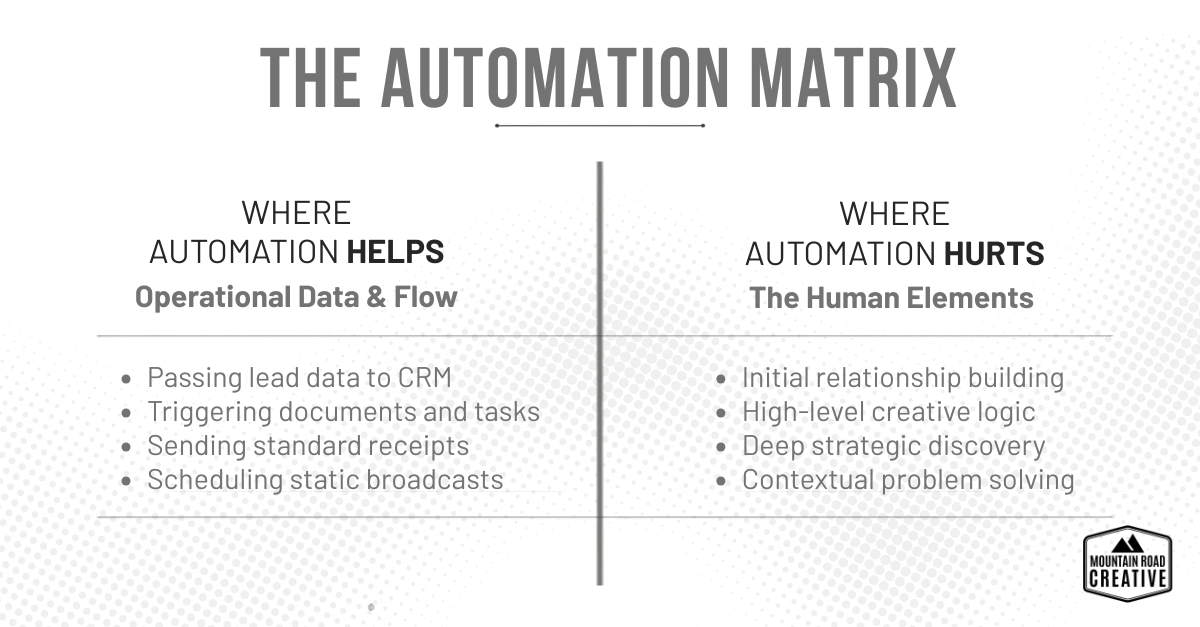
What This Looks Like: Where Automation Helps vs. Where It Hurts
To build a premium, retainer-based business model that operates smoothly, you must understand exactly where technology belongs and where it introduces friction.
Where It Hurts (The Human Element)
Where owners get into trouble is trying to automate relationship building. True premium buyers—the ones who value leverage, stability, and ongoing execution—can spot an automated interaction from a mile away.
Trying to automate personalized outreach, initial discovery conversations, or complex strategic nuances always results in a lower buyer signal. If a machine can do the thinking, the prospect assumes your service is a commodity. Creative direction, deep positioning work, and authentic human connection can never be outsourced to a sequence.
Where It Helps (The Operational Element)
Where automation shines is in the hand-offs. It belongs entirely in the administrative background.
Once a human has made a strategic decision or a client has taken a specific action, automation should step in to move the data seamlessly. For example, when a prospect fills out an application, automation should instantly route their data to your CRM, tag their interest profile, and send a clean, reliable confirmation email. It is the invisible spine that ensures nothing drops between the cracks, transforming marketing from a creative guessing game into a predictable operational function.
How This Should Run: Restructuring for True Leverage
If you want a marketing system that runs continuously without demanding your daily motivation, your technology must be bound by strict tool restraint. A mature marketing infrastructure should feel completely invisible to the founder.
This is how a sustainable, leveraged system should run:
1. Establish the Process Before the Platform
Never buy a piece of software until you have manually executed the process successfully at least ten times. If you cannot manage a lead pipeline using a simple, manual spreadsheet, a $300-a-month CRM will only allow you to lose track of leads faster and at a higher cost. Write down the steps on paper first. Only when the human workflow is flawless should you write a piece of code or build a integration to speed it up.
2. Enforce the 90-Day Tool Audit
Every piece of software in your marketing stack must earn its keep. If a tool has not been actively optimized, reviewed, or logged into by an operations owner in the last 90 days, it is a liability. It is either introduced unnecessary complexity or storing dead data. Lean organizations strip away peripheral applications and focus on maximizing the core utilities they already own.
3. Transition from Campaigns to Infrastructure
Unstable marketing relies on constant campaigns—the frantic energy of launching a new promo every month to hit a number. Autonomous marketing relies on infrastructure. Your website, your primary email engine, and your core messaging should be set up as permanent fixtures. They are designed to hold up over time, running continuously in the background regardless of whether the founder is sitting at their desk or taking a month off.

The Main Point: Automation Can Break but Systems Never Do
Software cannot fix an invisible strategy, and features cannot replace operational discipline. True marketing maturity means stepping back, looking at your business through the lens of leverage, and realizing that less is almost always more.
When you stop treating marketing as an improvised creative playground and start treating it as a predictable operational function, your business changes. You stop chasing tactics, and you start building equity.
If you are ready to identify exactly where your current tech stack is draining your energy instead of scaling your output, take the first step toward systemization. Once you’ve established a strong system with clear flows and outcomes, the automation falls into place.